
.jpg/1200w/webp/50q)
Most owners respond by:
- Shopping the market
- Raising deductibles
- Hoping for a better outcome next year
But today, that’s often not enough.
Some are taking a different approach, rethinking how their insurance is structured altogether.
Looking Beyond Traditional Insurance Solutions
In our previous article, we talked about how renters insurance can help offset costs and improve NOI.
But for larger portfolios, there’s another step.
Instead of treating insurance like a fixed expense, some owners are starting to treat it like something they can design and control.
Why This Matters
Most multifamily properties follow a similar pattern:
- High premiums every year
- Occasional, smaller losses
So the question becomes:
Are you paying to insure risk you could reasonably handle yourself?
For some owners, the answer is yes.
What is a Layered Property Insurance Strategy?
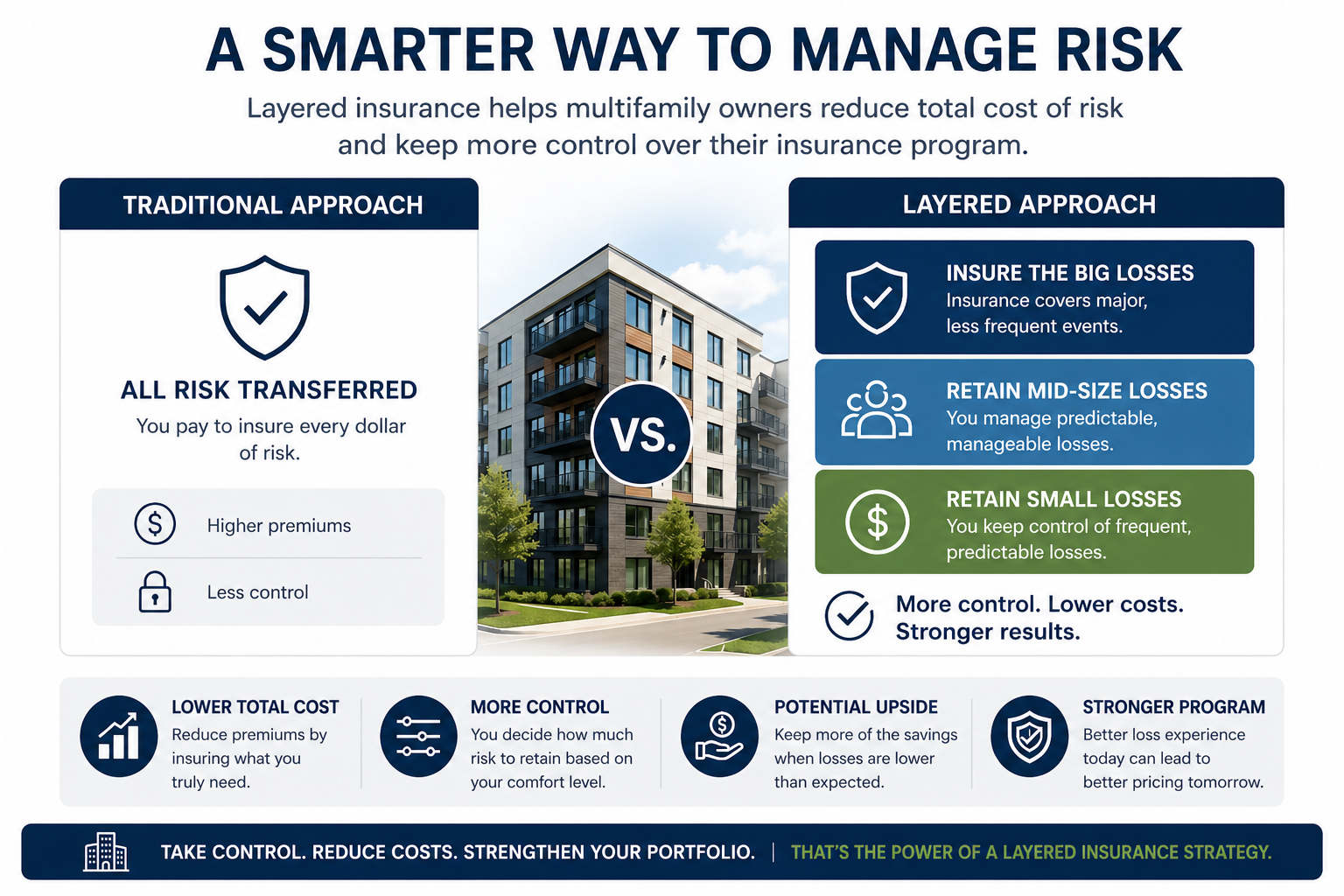
A growing strategy is called a layered insurance program.
At its core, it’s very simple:
You keep the smaller losses.
These are more predictable and can be managed internally.
You insure the larger losses.
These are less frequent but more severe, and still covered by traditional insurance.
A typical structure might look like:
- First $100K–$500K per claim → you handle
- Larger losses → insurance covers
This helps you avoid overpaying to insure every dollar of risk.
How This Approach Reduces Total Cost of Risk
Instead of sending all your premium to an insurance company, this approach can help you:
- Have more control over costs
- Reduce reliance on market swings
- Benefit when losses are lower than expected
It’s not about taking on more risk; it’s about taking on the right risk.
How Renters Insurance Strengthens Your Strategy
This strategy works even better if you already require renters insurance.
When tenants are properly insured:
- Tenant-caused damage is less likely to hit your policy
- Small claims are reduced
- Your loss history improves
If you have a captive renters insurance program, it can also generate income.
That income can help:
- Offset insurance costs
- Support the portion of risk you retain
- Improve overall performance
Why More Owners Are Doing This
Rising costs are cutting into NOI.
Insurance is a direct expense, so higher premiums mean lower profitability.
Not all risk needs to be transferred.
If your properties perform well, it may not make sense to insure every small loss.
More control leads to more stability.
This approach gives you more predictability year over year.
Is This the Right Approach for Your Portfolio?
Not every property is a good fit.
This approach tends to work best for:
- Larger portfolios
- Owners with consistent operations
- Properties with stable loss history
It also needs to align with lender requirements and long-term goals.
Final Thoughts: Taking Control of Insurance Costs
Insurance doesn’t have to be something you simply renew each year.
With the right structure, it can become a tool to:
- Control costs
- Improve NOI
- And support long-term performance
Have questions? Contact:

Telly Longhurst
Insurance Advisor
Call: (435) 752-1351Book an Appointment»
...
Read Telly's full bio